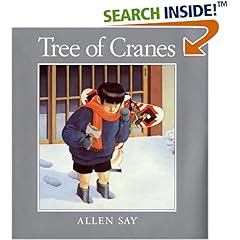
Tree of Cranes
by Allen Say
There is a distance in Allen Say books, a calm and separate peace.
Using his beautiful artful pieces with children is always an interesting moment. I read this today with my 1st graders. We are studying Asian works, cultural experience. We are folding paper cranes, making kites. We are trying to articulate the experience of cultures. We are living the experience of growing up figuring out who we are in “this” moment. And so this book suggested its way into my afternoon between a bluegrass band from Alaska and my returning from an AM test rather loopy and the need to have a lovely Friday.
I went looking for a book to speak through which I could convey feeling and thoughts not entirely within my grasp verbally or in written form. That led me of course to Say.
This story is beautifully/distantly told through his artwork and speaks to a child's ability to take an experience from childhood that shapes the him through perhaps a mistake, or a discomfort, a broken request, an intrusion into things unknown and maybe a bit frightening. It does touch guilt through the commission of a wrong that is translated then into life as an avoidance, impression, it symbolizes I think in a concrete way a door being shut. The child does what the mom has requested he not do, she fears, has always feared, he will drown in a carp pond. He then is drawn to the pond, falls in and lives of course. But immediately he is sick needing her comfort feels her withdrawal. He has physical care but senses an emotional distance. It is a symbol-laden piece. My children sat riveted, utterly riveted. Able to talk to me a great deal about this disappointing a mother with his exploration.
When Say relates the child's impression of his mother's response to his falling in the carp pond, the feeling of disapproval breaks all over you.
Sometimes I think coming out of my work with children, and my own past, sometimes I'm not looking for books about perfect harmony and comfort, compliments and the falseness of the etiquette systems that separate us from truth. Sometimes I am grateful and want to shout my thanks as a roar, or adoring and want the weeks of wagging my tongue on the ground in lapping love, sometimes I'm feeling a dissonance and want the strangeness wearing my hats, sometimes I am wanting to look at artwork by Dali, or the images of Close. Sometimes a Philip Pearlstein with the blue veins of a headless nude draped in a kimono in a rocker looking heavy and liquid is the type of concretization of this internal place I'm in and I want to look for a long while at an ugly thing. Say manages I think to catch a feeling that children do know. They would like I think to examine it a bit.
We know the relationship to other, be it in a mother or in the partner we ultimately are drawn to know better. A space, distance, curtain is drawn to our finding perfect understanding. My girl friend and I were speaking of the receiving of the female the holding and as I felt I understood for a second what becomes a oneness in the two partners male/female in the relationship it rose right out of my mind and fled. Seeking wholeness and unification I am lost in the way. Cannot intellectualize to knowing.
But not necessary to our acceptance. And that I think is important.
In this story the child feels the mother has withdrawn from him in someway from his actions and then time moves this into learning something more of her unexpectedly.
Two times in particular in my childhood I recall in the relationship to my mother and several more with my father incidents where the situation almost of my innocence lead me unexpectedly into a territory beyond my ability to process or speak about. Just found out something. And the resultant feeling of being left alone there with that, of being fully alone, a being separate was uncomfortable. But I recall it viscerally. In one particular incident when I learned of my mothers first marriage and her life before me just mildly asking her about a ring in her jewelry, it brought me a sense of disassociation. It is to this Say allows into his work here.
They suggest this is falling out of finding way to address his two-culture gap that certainly would fit here, a Mom of California with Christmas traditions and a life in a traditional Japanese home. This would fit my feelings I think a bit marrying into a very different kind of family, moving across a country, working in very different cultures than my Appalachian one in a South Central or a Salinas Valley Migrant town and then having my children while struggling to interpret “me” to them in these different contexts. My sense of them unable to "know” me and my own struggles with the roles, responsibilities, the carrying of my background, my talents, my feeling of the challenges has been so much like the experience of art. I understand it through art but that was my background.
The audience of an artwork receives within an other, an audience, a “themness.” It is not the place that made the work but there may be echoes or ripples in the lake. Sometimes the work made cannot speak through all of these veils. I recently read a long involved review of a painting. Long explanations of the artist’s circumstances, life, loves, techniques, developments of style, their historical context, actually the writing was a showpiece of encyclopedic and interpretive writing of a critic. As I read I felt less and less confident, more and more unworthy of looking at this piece, further and further removed from the meanings. With so little knowing to this level I thought perhaps I have no right to look and be with this work at all. I almost lost my stance in front of the work as if falling through the floor. Tilting.
And looking up I thought of myself as I paint and make. Thinking of my own meager work. But still considering the process and the pieces. Would I want all of that life and that evaluative interpretive critical layer really to be known by someone looking at the work? Could that be the way it should be seen? The evolution of my style, my statements or what I am deeply saying? Could anyone know, do I know? Was my making just there because I had no way to speak to things I do not know how to say?
Art is a separation in the talk. It is frozen time, it walks into the evoking of responses in the viewer. But what happens then often surprises me. When I looked again at this piece , about which I read, regaining myself I preferred my set of connections, though I was not hurt or disturbed by the interpreter/critic piece. I just heard something from an artist and it was special to me too. It is that dissonance I always find in Says’ stories. It speaks to me very privately and my private feelings we hold alone.
Origami cranes brought me to this book too, expressions of flight, of folding them for the celebrations of the fleeting nature and beauty of a life. I like to make them. I like to touch paper. It is a kind of religion for me. Peace. You'd like this.
Sadako Story

I just received beautiful gifts donated for my class. Here is the list they used.
The gesture of this very moving to the whole school, or those that know of it, with many aware. It was the loveliest of things to do I’m actually shocked. And I did disassociate really. I connected to the kind of feeling that my children in my class know a teacher that speaks a language they are just learning, experience daily the discomforts of interpreting me, a very different person, the school, the differences from home. They know there is a world, but not yet if it is a town or a country, not really where a friend might be thinking of giving them a gift.
But I watched. They know the concrete joy of playing with the blocks, or setting up the reptile habitat, or the joy of hearing a book. But they grasp fleetingly something more than this. They are able to grasp that I hold something "else” that comes into play as I share these special gifts with them. We sense the things speak other languages to me. I am honored. And in my way these things honor for me the importance of my children.
Like the paper cranes that are folded within this story to decorate the Christmas tree of this child’s mother with her distances, the cranes are folded as symbols beautifully dimensional, momentarily alluding to the ideal of the gesture. The flight, the crane as it lifts up and into the sky. A paper to say my heart lifts to you dearly; your kindness is folded into the totality of where I am now, lifting you into the mind's eye.
Or so it is for me.
Say’s child senses that his parent is him, yet not him. They have been united; he was inside of her womb and shares their past but that their flights are their own. As soon as we hold the painting to go to something I can use to explain, in the time of our looking, in our flash of insights it escapes us into a kind of flight. Our next meeting, our next experience to be both familiar but also the possibility of a different, refreshed, unknown newness for us.
This child carries sadness from this day and a joy, something felt as his mistake, he could not know playing in the carp pond again without feeling that he would evoke disappointment from his mom. I relate this a bit to my gifting, I would like to be able to share with these friends something that might be worth their kindness, my class being so dear to me I share them as the beautiful and special persons that I hope will live in their world touching the lives of others as positively.
I wish almost with wistfulness that these children could really be known as expressions of the miracle of life, the possibility in life. I had a child last year so dear to me. I look at her photo knowing that I shared her with a friend, writing of her adventures, to try to give something of myself and this place we live within lacking anything else really of worth to ever give.
Ah. Maybe I am not up to the expression in words of Say. He made a book that I find unique in children's literature It asks of us a willingness to be uncomfortable, to be changes, to speak to deep rivers running through us. As we reach the sea a part of the humanity of the life we have experienced a book such as this allows us to say that there is so much we will not know, never explain, that affected us profoundly and moved through us. A part of the water, the river the sea and yet held within the self, our concrete self. A drop. Look at his cover as a child tries to understand who he is.
No comments:
Post a Comment
I am now moderating comments.