It is so powerful you really must listen. Really it is worth the time.
So here is the link..I hope...
The Reading Mind
A neuroscientist explains how reading shapes the human mind, and what happens when reading stops.
And here is the blurb I hope I can copy here...
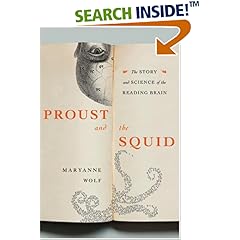
is sitting in the back of my car along with a book by Maslow, I love it,
(The Farther Reaches of Human Nature (An Esalen Book) by Abraham H. Maslow, Henry Geiger, and Bertha G. Maslow)
and a host of others I meant to shift to the piles in the kitchen or the piles in my bedroom or hall over break. They fly around when I go around curves, sometimes appearing under the seat.
I have to admit here however, a bit off subject, I read this recently too, it's beautiful:

Proust Was a Neuroscientist
by Jonah Lehrer
How is it possible that the two books carry such similar titles and very interesting lines of thought? Perhaps read together they would be a very good day spent by the beach in a Spring Break or summer vacation. A lot of my reading is in the car waiting on kids, or in some office waiting a med test, or sitting at my lunch stealing a few minutes. But this break, awfully sick, we still got in a bit of reading. And listening.....and walking.
We have books everywhere. And yet I'm noticing in the last five years I read bits of books, five books simultaneously, read books in combinations, maybe from the back, or flip inside the middle, or while multi-tasking, or on-line, listen to them, down load them, listen while drawing, writing, or on-line messing around in shorter and shorter burst of something that once seems dreamily recalled as a now fading deeper level of concentration ( old days you know, the days we always must recover). I feel a shift and just look at it without judging, and the program is really about that...it is about the nature of reading and the wiring of our brain. Not the non judging, that's me adding in another line of thought.
And it's about change in reading, overall.
Go here to see the place I began tonight on the NPR piece.
Lovely excerpt from the book to read there, and it is a great place to link into "On Point" a show I really enjoy. Podcasts now. That darn Boston, has it all...
From my notes listening :
Reading changes the brain, they point out. In it's activation, the brain's being re-aligned through the reading process she states and here discussed in terms of children's acquiring this process of reading-this is fascinating. as is really her book.
I teach reading, this is the stuff of what I am called to do. (So here are some quick notes, sort of thrown together followed by somewhere else I went this morning thinking about language and knowledge and perhaps very different searches for ultimate understanding)
This piece is one strong argument for bringing our children into books. Strongly emphasizing how important this reading has been for shaping our world. Our civilization.
Maryanne Wolf , professor of child development at Tufts University and author of "Proust and the Squid: The Story and Science of the Reading Brain," is talking about the expansion of the brain that reading grows, this then altering the evolution of the brain, through the recording of history, a process of shaping the brain through saved, recorded, shared experience, recording of altering cultural/group experience...here she talks to the the plasticity of the brain to be able to do this..hard to quote. So reading shapes our brain. Not coming naturally, it's learned and it's work.
Reading has been taught, then she tells us, and when it becomes automatic we are changing fundamentally the brain's operationing capacities. She talks about us (now in time) in our brain research and understanding as if we are in a moment of cartography. She states neuro-scientists are looking at mapping the way a function like reading criss crosses the brain. Reading, she says, is connecting the wires we have in a new way, reading is also individually learned. So an attainment that is individual within a collective society. Reading as an invention to reconnect the parts of the brain in a "new way." I thought that very interesting. Studying too the ways the parts of the brain work or change, rewire maybe, as a new reader becomes automatic, the refinement of the connections, the strengthening, this would be talking to the plasticity.
Wolf says reading then allows the brain to have a new territory available for use.
If you know how much of linguistics is hung on the map or the territory, how referent this is to this area of study you understand her choice of wording is a deliberate one.
She describes that after that 1st year of learning to read, a year that is very decoding and skills based, the separate skills acquired are now optimizing through practice and become faster, you see activated the parts of the brain for imagination, thinking, insight, analysis, culture building, it all becomes available for use. This is so interesting as teaching third grade versus 1st is like the difference between a skill and a melody. It just is very amazing. The wonder in teaching and moving around in the process to experience the differences a few years makes in capacities of a child. (And it could also be noted to experience the differences of that happening in a reading based school system when a child does not read versus a peer that does. When I've shifted around teaching it brings this home, that our system is based on reading success as the main way to be a success, there are few other ways to look and few things built for kids as alternative. Broadly that's painted here)
She spends time talking of Socrates and his thoughts of oral language, his suspicion of reading...hum. It would seem he thought reading might become a decoding activity and advocated the oral traditions. My father was seeped in Socrates. His lectures in college I attended, never were any like I saw in school, unlike each other his sessions, he drew all he needed to teach economics by coming to know each student well, involving all in the evolving of understandings. Whether one read the books or not, you were going to be drawn into the work collectively and then as a by product most of his students read the books to be better able to meet him in this process. His was a construction approach. It started in needing to know, a question. Dad could really teach. I sat in his lectures and to be truthful he was the best college teacher/lecturer I've ever seen. I've never seen anyone trust students to this degree to enjoy and engage learning on an individual level and discussion to that level. Socrates was his answer, he said. He contended those oral interactions, personal history, were the places that the things in the books were applied into the lives, contexts, understandings of the students. It was then, maybe, I have a glimmer of thought about what she is alluding to in Socratic concerns about a shift to reading over oral tradition. One an experience in a very personal, mentoring, face to face interactive and social experience. But this is an insertion of my own connection. Sorry.
Reading then is portrayed as a doorway into this amazing capacity for inference et al , more efficient than oral language she states. But she defers to Socrates, talks of his fears about reading over oral language to talk to her own set of "somewhat" concerns... but she says in the end actually reading allowed democratization, more access to more people for inference, for the kind of expansion of mind, putting to rest for her his misgivings. I'm not entirely sure I resolved this line of thought.
And yet as she reveals her new set of fears within a digital revolution...I've heard this in teaching, in pieces here and there, about the "loss of readers." The program host talked about how little reading is occurring now, the changes in this seen in surveys about reading. Very great concerns about that in all of us coming in part from the digital revolution. They sited the surveys about how many books have been read in a year per person. I'm never called for those surveys, are you???. For the past 5 years I recorded the books I've read, or partially read. I'm working on 1,000. That might up the averages. Here I am reading survey people, available. That phone is not ringing.
She has thoughts about the possibly that there will be a stunting of this deep reading capacity, brain rewiring, automatic critical thinking cut off before it's complete formation for children in the digital revolution, this she is wondering about...and how to preserve this development....and she states it is a developmental construct... within the changes occurring in the digital revolution partially in how the early formation and work with students might co-opt within this process of the development of the aromaticity of reading and the neural structuring involved.
So that really is extremely relevant to my job teaching reading especially since I work with the kids hearing less oral English and exposed through poverty to far less text based experience, who are now in a reading based game. Disadvantaged day one. And very relevant when I have seen the removal of literature from classrooms for phonics based skill process, books that once because of connection to theme and motivation encouraged much more meaning based practice than I see now. I see now practice in "fluency" in dittoed materials called "Goats Groat" not in books that were fun and engaging with lovely characters and situations to visualize. I see the real deprevation everytime we clunk open the series and basal for in my district that's all they allow in this early stage. And the results are overwhelmingly NARROW.
Wolf was defining that has occurred within the nature of the individual reading process in digital mediums.Or asks this be pondered in critical ways. Cautions about the precious gift of reading. Her worry is that we will not have the critical thinking and aromaticity formed fully before the migration into the digital medium. She is simply encouraging keeping and forming "the reading brain." Know what you are doing and why.
So risking ...reading less... might ....be limiting democracies underpinings.
That was rather interesting. And I'm looking at that everyday in my work.
It is the free right to opinion and reasoning, self-rule that developed within the access through books and reading, this is asserted. Yes, this seems fascinating to follow, an assumption they trace to Jefferson. I read recently a fascinating piece connected to this. Shakespeare and the American Nation. Well it has some connection in my mind...in it's assumptions perhaps. What an argument could occurs here for access to reading, libraries, reading. It is my contention a laptop per child gives another kind of democratization...however.
Creative "quality" Wolf says is at the heart of reading .....the memory of previous reading gets connected at the individual level ...so "we are what we read"....the stuff of what our children are reading is now into the digital age, Wolf fears, this is not perhaps the same quality, amount, type, as that which we have taken for granted as part of "our formation." She clarifies that the mind is trained to be a critical mind, it was formed through the reading process in the past process she says a deep form of reading (a deep structure to language citing Chomsky somewhat) , so....we are trained to be a critical mind, set to infer, to analyze, our formation was to probe , think deeply with reading.
She sees a difference in on-line presentation.
She says she has a caution that children will be deluded to think they know it all when they have not gone on to a deeper level, from a surface level. Deep structure to language and a surface structure emerge for her, decoders now are not trained to do this deeper work in the present models for children...this concerns the writer. (Concerns me too if accurate. Are these assumptions real? Do I accept these notions? Would a brain configured through something other than reading in a book equally shape the brains deep construction, but along other lines? Say if one super developed visualization, physicality? Are the developments available through reading, through this stored experience, actually stored experience in a clear light? Or stored distortions? Are they cognitively binding? Replicating patterns that are positive? Is this the greatness or the seeds of repetitions? I had a great many complicated thoughts. I had thoughts that perhaps digital medium brought many other things...an expansion....of mind. Just in this little podcast, I could hear this, that's pretty incredible, I needed to think a bit. About her concerns and read the book again to better recall how she presented this in her book's context.)
In the digital age she is asking for study to understand what may be happening. A caller brings thoughts then...about his noticing in his teaching work kids who read well readily empathize, are able to visualize, have deeper understanding of world, emotional connectivity... we can internalize "though time" by reading thousands of years of history.
Transition from literacy epoch to a digital epoch.....this is what she is looking at she states.
Socratic looked at a transition of oral to written, so now she is wondering about lessons in these transition, she stated Socrates worried we'd only be decoding over a form of internal knowledge to use where we are. Modes of presentation preserve knowledge, internalization of knowledge will it be preserved she asks when we have no need for it? Will it be preserved? This I listened to three times and still would like better understanding of what she is asserting.
Then she shifts into a discussion of character in kids books, how this helps to develop a connection to our empathy. Through reading these stories children are fostering empathy strands. These characters that move our feelings actually are hooking in capacities we have. Form connections to empathy. Then noting the pattern recognition in reading, in other ways how that skill gets logged into the brain relating to patterns within the skill of reading.This is more on the brain re-wiring actually.
Then they shifted to another guest, Constance Steinkuehler, professor of educational communication and technology, University of Wisconsin at Madison that studies digital learning with children with difficult relationships to learning...she studies game cultures in students that are redefining their way into learning ......she studies a shift from consumption to production in terms of how a child uses technology. She talks of a similar democratization but turned on it's ear making me laugh...one that to her is brought through digital tools that allow you to "produce things." One might call it "go beyond them."
Then it's asked, is it depth? Value? Are you really "reading"?
She demonstrates lots of on-line reading, a wide amount of this goes on in her looks of gaming. She sees in her studies patterns that reading is still in the picture, but activities are organized differently. This medium shifting the way the reading occurs. Steinkuehler talks of a game about Civilization, a way to reengage kids in history as a question, through play. It seems a quite complex game to play. Kids then used history textbook as a cheat to play the game better. The books become helpful and relevant and they were motivated into that reading to beat the game...this a different interface with reading. But at it's heart we are talking about the motivation into reading. I think this is something to note.
This is why I continually reach for Maslow. It would seem kids are not test motivated, they may indeed need a very different kind of thing from us to connect them into learning. Yeah. No kidding.
Then the "long form of book reading such as Proust" versus something... implied as less...is discussed as patterns of consumption. This shift in students is considered (away from book consumption) I might suggest that adults are a bit "challenged" here....and her book worth considering in that light. because they are not consumers in a digital medium to understand fully it's gifts and implications. Nor are they looking at loads of studies.
So the digital scientist wants studied now these shifts of attention in students. This scientist is really great suggesting that they are avoiding definitions of what is literacy and what reading is...very intelligent way to suggest there are some other very important definitional strands to consider, but she will lead us into motivation here. Cognitive attention is changing in digital medium she states, multi-tasking emerges, platforms, several focuses. Now we are on to the essential piece to discuss and study.
Are we reading now in "a different structure?"
Certainly, I see this in my students. It hints to new teaching methodology and understanding.
Real changes that on some days rather scare me in their challenges FOR ME.
Different attention, different kinds of multi platform ability. Ashbrook reaches a different way...Is this connected to aging is suggested? Prolonging the capacities of the brain for longer times to live longer? Wow, way to go a different and equally interesting way. Showing me the way social interaction and individual meaning is so astounding.
A man asks, is this differing attention, helping one age better....Another caller asks and talks of her being older and noticing a real inability to read in long form, she feels barely able read, and is unable to sustain more than short term attention. She's asking is this deterioration of the brain with menopause and her aging process.
But I thought...are we changing with the digital capacity our concentration, how is that changing?
That seems an essential thing to continue to pursue, understand as a teacher.
So then within this cloud of concentration....the guest Wolf talks about how work with language activates the brain, notes to the listener who is a female aging, that memory loss of menopause is explained as a "during this time" struggle, not a permanent inability to concentrate in reading.
Continuous partial attention, mind on so many topics at a time,Wolf talks to as being something that "needs consideration. "
Mind, she says, wants closure on one topic so when drawn across so many topics at a time...that critical formation, long formation term, how we form knowledge in young children is going to be hurt in the process to deeper structuring potentially. Her words.
She keeps returning to this concern of the digital age in the formation of this very crucial reading mind. Her concern...that this capacity forms within the book....leads to her ...ask questions about the concentration. (Certainly I've seen it and am trying to think. It leads me recently to reading, watching, considering attentional issues.)
A reader calls talking about what the content of reading carries, that it very well often carries our prejudices, mis-information, distortions of culture, negatives as well as positive. Deep negatives. This caller talked about so many non-readers in the world, asks about their rights to democracy, it is actually just available or righteous to readers? ...a question I think worth volumes of discussion, experiences over reading...a vast west/east perhaps? The caller essentially challenges all assumptions here. Literacy standing for western progress...the digital scientist denies this, but .......
The writer Wolf says this is an argument of knowledge, not about is a book reader a better thing, but inherent in all she says is western tradition, heck she is coming from Socrates, western traditions and positions defining the reading brain as the cup of civilization and knowledge but the program is winding down, and how is this related to the digital brain...and we get cut off. This is worth a program...
They end with Proust...that the Heart of reading can go beyond the authors wisdom until we are then forming our own...truth?
So with those notes I recommend the book....more...listen to this podcast. I'm very fond of oral interactions. There is something fascinating to listening.
Made my notes and writing here working as I listened three or four times over. Had I been able to sustain my energy 5 or 6 times through would be even better. Finally. Now that is truly something to bring to students, NPR fans. That's revolutionary. I wish the text to the program, transcripts were also available. Nothing better. Hear it, read it, read and hear it, type notes to it, process, add in personal commentary, share. Wow. Exciting.
I'm currently reading Zen Keys by Thich Nhat Hahn. It was precisely the later part of this show reminding me where I was reading this morning. This is a book of Zen. It is something I cannot pretend to offer you as my understanding is logged intellectually. It is a book that walks me. Still something echoed. Because Wolf talked to knowledge it reminded me of the words I read talking to truth within this book, but a small piece in my day. The book is many pebbles..
The funny thing is on some level the latter caller to the program brought into my listening questions about our valuing, about the underpinnings of this writer. Something to consider in my reading.
And here is the blurb I hope I can copy here...
The Reading Mind Aired: Friday, April 11, 2008 11-12PM ETIt's very funny tro me because the book Proust and the Squid, this very book under deep discussion :
By host Tom Ashbrook:
Marcel Proust may have said it best. "I believe," said the great French novelist, "that reading, in its original essence, is that fruitful miracle of a communication in the midst of solitude."
Now, neuroscientist Maryanne Wolf says yes, but it's more than that. The human brain, she says, is endlessly pliable. A generation of research that began on the humble squid shows that the very act of reading itself actually shapes the human brain. And reading has shaped our history, our culture, our civilization.
Now, in the digital age, we are reading less. She sees devolution.
This hour On Point: reading, Proust and the squid.
· Maryanne Wolf, professor of child development at Tufts University and author of "Proust and the Squid: The Story and Science of the Reading Brain" · Constance Steinkuehler, professor of educational communication and technology, University of Wisconsin at Madison · Jack Beatty, On Point news analyst and senior editor at The Atlantic Monthly


is sitting in the back of my car along with a book by Maslow, I love it,
 |
and a host of others I meant to shift to the piles in the kitchen or the piles in my bedroom or hall over break. They fly around when I go around curves, sometimes appearing under the seat.
I have to admit here however, a bit off subject, I read this recently too, it's beautiful:
Proust Was a Neuroscientist
by Jonah Lehrer
How is it possible that the two books carry such similar titles and very interesting lines of thought? Perhaps read together they would be a very good day spent by the beach in a Spring Break or summer vacation. A lot of my reading is in the car waiting on kids, or in some office waiting a med test, or sitting at my lunch stealing a few minutes. But this break, awfully sick, we still got in a bit of reading. And listening.....and walking.
We have books everywhere. And yet I'm noticing in the last five years I read bits of books, five books simultaneously, read books in combinations, maybe from the back, or flip inside the middle, or while multi-tasking, or on-line, listen to them, down load them, listen while drawing, writing, or on-line messing around in shorter and shorter burst of something that once seems dreamily recalled as a now fading deeper level of concentration ( old days you know, the days we always must recover). I feel a shift and just look at it without judging, and the program is really about that...it is about the nature of reading and the wiring of our brain. Not the non judging, that's me adding in another line of thought.
And it's about change in reading, overall.
Go here to see the place I began tonight on the NPR piece.
Lovely excerpt from the book to read there, and it is a great place to link into "On Point" a show I really enjoy. Podcasts now. That darn Boston, has it all...
So on Amazon...about Proust and the Squid....so you know ....if you don't...
Wolf, a professor of child development at Tufts University, integrates psychology and archaeology, linguistics and education, history and neuroscience in a truly path-breaking look at the development of the reading brain-a complicated phenomenon that Wolf seeks to chronicle from both the early history of humanity and the early stages of an individual's development ("unlike its component parts such as vision and speech... reading has no direct genetic program passing it on to future generations"). Along the way, Wolf introduces concepts like "word poverty," the situation in which children, by age five, have heard 32 million less words than their counterparts (with chilling long-term effects), and makes time for amusing and affecting anecdotes, like the only child she knew to fake a reading disorder (attempting to get back into his beloved literacy training program). Though it could probably command a book of its own, the sizable third section of the book covers the complex topic of dyslexia, explaining clearly and expertly "what happens when the brain can't learn to read." One of those rare books that synthesizes cutting edge, interdisciplinary research with the inviting tone of a curious, erudite friend (think Malcolm Gladwell), Wolf's first book for a general audience is an eye-opening winner, and deserves a wide readership.
Copyright © Reed Business Information, a division of Reed Elsevier Inc. All rights reserved.
From my notes listening :
Reading changes the brain, they point out. In it's activation, the brain's being re-aligned through the reading process she states and here discussed in terms of children's acquiring this process of reading-this is fascinating. as is really her book.
I teach reading, this is the stuff of what I am called to do. (So here are some quick notes, sort of thrown together followed by somewhere else I went this morning thinking about language and knowledge and perhaps very different searches for ultimate understanding)
This piece is one strong argument for bringing our children into books. Strongly emphasizing how important this reading has been for shaping our world. Our civilization.
Maryanne Wolf , professor of child development at Tufts University and author of "Proust and the Squid: The Story and Science of the Reading Brain," is talking about the expansion of the brain that reading grows, this then altering the evolution of the brain, through the recording of history, a process of shaping the brain through saved, recorded, shared experience, recording of altering cultural/group experience...here she talks to the the plasticity of the brain to be able to do this..hard to quote. So reading shapes our brain. Not coming naturally, it's learned and it's work.
Reading has been taught, then she tells us, and when it becomes automatic we are changing fundamentally the brain's operationing capacities. She talks about us (now in time) in our brain research and understanding as if we are in a moment of cartography. She states neuro-scientists are looking at mapping the way a function like reading criss crosses the brain. Reading, she says, is connecting the wires we have in a new way, reading is also individually learned. So an attainment that is individual within a collective society. Reading as an invention to reconnect the parts of the brain in a "new way." I thought that very interesting. Studying too the ways the parts of the brain work or change, rewire maybe, as a new reader becomes automatic, the refinement of the connections, the strengthening, this would be talking to the plasticity.
Wolf says reading then allows the brain to have a new territory available for use.
If you know how much of linguistics is hung on the map or the territory, how referent this is to this area of study you understand her choice of wording is a deliberate one.
She describes that after that 1st year of learning to read, a year that is very decoding and skills based, the separate skills acquired are now optimizing through practice and become faster, you see activated the parts of the brain for imagination, thinking, insight, analysis, culture building, it all becomes available for use. This is so interesting as teaching third grade versus 1st is like the difference between a skill and a melody. It just is very amazing. The wonder in teaching and moving around in the process to experience the differences a few years makes in capacities of a child. (And it could also be noted to experience the differences of that happening in a reading based school system when a child does not read versus a peer that does. When I've shifted around teaching it brings this home, that our system is based on reading success as the main way to be a success, there are few other ways to look and few things built for kids as alternative. Broadly that's painted here)
She spends time talking of Socrates and his thoughts of oral language, his suspicion of reading...hum. It would seem he thought reading might become a decoding activity and advocated the oral traditions. My father was seeped in Socrates. His lectures in college I attended, never were any like I saw in school, unlike each other his sessions, he drew all he needed to teach economics by coming to know each student well, involving all in the evolving of understandings. Whether one read the books or not, you were going to be drawn into the work collectively and then as a by product most of his students read the books to be better able to meet him in this process. His was a construction approach. It started in needing to know, a question. Dad could really teach. I sat in his lectures and to be truthful he was the best college teacher/lecturer I've ever seen. I've never seen anyone trust students to this degree to enjoy and engage learning on an individual level and discussion to that level. Socrates was his answer, he said. He contended those oral interactions, personal history, were the places that the things in the books were applied into the lives, contexts, understandings of the students. It was then, maybe, I have a glimmer of thought about what she is alluding to in Socratic concerns about a shift to reading over oral tradition. One an experience in a very personal, mentoring, face to face interactive and social experience. But this is an insertion of my own connection. Sorry.
Reading then is portrayed as a doorway into this amazing capacity for inference et al , more efficient than oral language she states. But she defers to Socrates, talks of his fears about reading over oral language to talk to her own set of "somewhat" concerns... but she says in the end actually reading allowed democratization, more access to more people for inference, for the kind of expansion of mind, putting to rest for her his misgivings. I'm not entirely sure I resolved this line of thought.
And yet as she reveals her new set of fears within a digital revolution...I've heard this in teaching, in pieces here and there, about the "loss of readers." The program host talked about how little reading is occurring now, the changes in this seen in surveys about reading. Very great concerns about that in all of us coming in part from the digital revolution. They sited the surveys about how many books have been read in a year per person. I'm never called for those surveys, are you???. For the past 5 years I recorded the books I've read, or partially read. I'm working on 1,000. That might up the averages. Here I am reading survey people, available. That phone is not ringing.
She has thoughts about the possibly that there will be a stunting of this deep reading capacity, brain rewiring, automatic critical thinking cut off before it's complete formation for children in the digital revolution, this she is wondering about...and how to preserve this development....and she states it is a developmental construct... within the changes occurring in the digital revolution partially in how the early formation and work with students might co-opt within this process of the development of the aromaticity of reading and the neural structuring involved.
So that really is extremely relevant to my job teaching reading especially since I work with the kids hearing less oral English and exposed through poverty to far less text based experience, who are now in a reading based game. Disadvantaged day one. And very relevant when I have seen the removal of literature from classrooms for phonics based skill process, books that once because of connection to theme and motivation encouraged much more meaning based practice than I see now. I see now practice in "fluency" in dittoed materials called "Goats Groat" not in books that were fun and engaging with lovely characters and situations to visualize. I see the real deprevation everytime we clunk open the series and basal for in my district that's all they allow in this early stage. And the results are overwhelmingly NARROW.
Wolf was defining that has occurred within the nature of the individual reading process in digital mediums.Or asks this be pondered in critical ways. Cautions about the precious gift of reading. Her worry is that we will not have the critical thinking and aromaticity formed fully before the migration into the digital medium. She is simply encouraging keeping and forming "the reading brain." Know what you are doing and why.
So risking ...reading less... might ....be limiting democracies underpinings.
That was rather interesting. And I'm looking at that everyday in my work.
It is the free right to opinion and reasoning, self-rule that developed within the access through books and reading, this is asserted. Yes, this seems fascinating to follow, an assumption they trace to Jefferson. I read recently a fascinating piece connected to this. Shakespeare and the American Nation. Well it has some connection in my mind...in it's assumptions perhaps. What an argument could occurs here for access to reading, libraries, reading. It is my contention a laptop per child gives another kind of democratization...however.
Creative "quality" Wolf says is at the heart of reading .....the memory of previous reading gets connected at the individual level ...so "we are what we read"....the stuff of what our children are reading is now into the digital age, Wolf fears, this is not perhaps the same quality, amount, type, as that which we have taken for granted as part of "our formation." She clarifies that the mind is trained to be a critical mind, it was formed through the reading process in the past process she says a deep form of reading (a deep structure to language citing Chomsky somewhat) , so....we are trained to be a critical mind, set to infer, to analyze, our formation was to probe , think deeply with reading.
She sees a difference in on-line presentation.
She says she has a caution that children will be deluded to think they know it all when they have not gone on to a deeper level, from a surface level. Deep structure to language and a surface structure emerge for her, decoders now are not trained to do this deeper work in the present models for children...this concerns the writer. (Concerns me too if accurate. Are these assumptions real? Do I accept these notions? Would a brain configured through something other than reading in a book equally shape the brains deep construction, but along other lines? Say if one super developed visualization, physicality? Are the developments available through reading, through this stored experience, actually stored experience in a clear light? Or stored distortions? Are they cognitively binding? Replicating patterns that are positive? Is this the greatness or the seeds of repetitions? I had a great many complicated thoughts. I had thoughts that perhaps digital medium brought many other things...an expansion....of mind. Just in this little podcast, I could hear this, that's pretty incredible, I needed to think a bit. About her concerns and read the book again to better recall how she presented this in her book's context.)
In the digital age she is asking for study to understand what may be happening. A caller brings thoughts then...about his noticing in his teaching work kids who read well readily empathize, are able to visualize, have deeper understanding of world, emotional connectivity... we can internalize "though time" by reading thousands of years of history.
Transition from literacy epoch to a digital epoch.....this is what she is looking at she states.
Socratic looked at a transition of oral to written, so now she is wondering about lessons in these transition, she stated Socrates worried we'd only be decoding over a form of internal knowledge to use where we are. Modes of presentation preserve knowledge, internalization of knowledge will it be preserved she asks when we have no need for it? Will it be preserved? This I listened to three times and still would like better understanding of what she is asserting.
Then she shifts into a discussion of character in kids books, how this helps to develop a connection to our empathy. Through reading these stories children are fostering empathy strands. These characters that move our feelings actually are hooking in capacities we have. Form connections to empathy. Then noting the pattern recognition in reading, in other ways how that skill gets logged into the brain relating to patterns within the skill of reading.This is more on the brain re-wiring actually.
Then they shifted to another guest, Constance Steinkuehler, professor of educational communication and technology, University of Wisconsin at Madison that studies digital learning with children with difficult relationships to learning...she studies game cultures in students that are redefining their way into learning ......she studies a shift from consumption to production in terms of how a child uses technology. She talks of a similar democratization but turned on it's ear making me laugh...one that to her is brought through digital tools that allow you to "produce things." One might call it "go beyond them."
Then it's asked, is it depth? Value? Are you really "reading"?
She demonstrates lots of on-line reading, a wide amount of this goes on in her looks of gaming. She sees in her studies patterns that reading is still in the picture, but activities are organized differently. This medium shifting the way the reading occurs. Steinkuehler talks of a game about Civilization, a way to reengage kids in history as a question, through play. It seems a quite complex game to play. Kids then used history textbook as a cheat to play the game better. The books become helpful and relevant and they were motivated into that reading to beat the game...this a different interface with reading. But at it's heart we are talking about the motivation into reading. I think this is something to note.
This is why I continually reach for Maslow. It would seem kids are not test motivated, they may indeed need a very different kind of thing from us to connect them into learning. Yeah. No kidding.
Then the "long form of book reading such as Proust" versus something... implied as less...is discussed as patterns of consumption. This shift in students is considered (away from book consumption) I might suggest that adults are a bit "challenged" here....and her book worth considering in that light. because they are not consumers in a digital medium to understand fully it's gifts and implications. Nor are they looking at loads of studies.
So the digital scientist wants studied now these shifts of attention in students. This scientist is really great suggesting that they are avoiding definitions of what is literacy and what reading is...very intelligent way to suggest there are some other very important definitional strands to consider, but she will lead us into motivation here. Cognitive attention is changing in digital medium she states, multi-tasking emerges, platforms, several focuses. Now we are on to the essential piece to discuss and study.
Are we reading now in "a different structure?"
Certainly, I see this in my students. It hints to new teaching methodology and understanding.
Real changes that on some days rather scare me in their challenges FOR ME.
Different attention, different kinds of multi platform ability. Ashbrook reaches a different way...Is this connected to aging is suggested? Prolonging the capacities of the brain for longer times to live longer? Wow, way to go a different and equally interesting way. Showing me the way social interaction and individual meaning is so astounding.
A man asks, is this differing attention, helping one age better....Another caller asks and talks of her being older and noticing a real inability to read in long form, she feels barely able read, and is unable to sustain more than short term attention. She's asking is this deterioration of the brain with menopause and her aging process.
But I thought...are we changing with the digital capacity our concentration, how is that changing?
That seems an essential thing to continue to pursue, understand as a teacher.
So then within this cloud of concentration....the guest Wolf talks about how work with language activates the brain, notes to the listener who is a female aging, that memory loss of menopause is explained as a "during this time" struggle, not a permanent inability to concentrate in reading.
Continuous partial attention, mind on so many topics at a time,Wolf talks to as being something that "needs consideration. "
Mind, she says, wants closure on one topic so when drawn across so many topics at a time...that critical formation, long formation term, how we form knowledge in young children is going to be hurt in the process to deeper structuring potentially. Her words.
She keeps returning to this concern of the digital age in the formation of this very crucial reading mind. Her concern...that this capacity forms within the book....leads to her ...ask questions about the concentration. (Certainly I've seen it and am trying to think. It leads me recently to reading, watching, considering attentional issues.)
A reader calls talking about what the content of reading carries, that it very well often carries our prejudices, mis-information, distortions of culture, negatives as well as positive. Deep negatives. This caller talked about so many non-readers in the world, asks about their rights to democracy, it is actually just available or righteous to readers? ...a question I think worth volumes of discussion, experiences over reading...a vast west/east perhaps? The caller essentially challenges all assumptions here. Literacy standing for western progress...the digital scientist denies this, but .......
The writer Wolf says this is an argument of knowledge, not about is a book reader a better thing, but inherent in all she says is western tradition, heck she is coming from Socrates, western traditions and positions defining the reading brain as the cup of civilization and knowledge but the program is winding down, and how is this related to the digital brain...and we get cut off. This is worth a program...
They end with Proust...that the Heart of reading can go beyond the authors wisdom until we are then forming our own...truth?
So with those notes I recommend the book....more...listen to this podcast. I'm very fond of oral interactions. There is something fascinating to listening.
Made my notes and writing here working as I listened three or four times over. Had I been able to sustain my energy 5 or 6 times through would be even better. Finally. Now that is truly something to bring to students, NPR fans. That's revolutionary. I wish the text to the program, transcripts were also available. Nothing better. Hear it, read it, read and hear it, type notes to it, process, add in personal commentary, share. Wow. Exciting.
I'm currently reading Zen Keys by Thich Nhat Hahn. It was precisely the later part of this show reminding me where I was reading this morning. This is a book of Zen. It is something I cannot pretend to offer you as my understanding is logged intellectually. It is a book that walks me. Still something echoed. Because Wolf talked to knowledge it reminded me of the words I read talking to truth within this book, but a small piece in my day. The book is many pebbles..
" The doctrine of non-self aims at bringing to light the interbeing nature of thing and, at the same time, demonstrates to us that the concepts we have of things do not reflect and cannot convey reality. Conceptual knowledge is not the perfect instrument for studying truth. Words are inadequate to express the truth of ultimate reality.
Skipping a bit..
But if conceptual knowledge is fallible, what other instrument should we use to grasp reality? According to Buddhism, we only reach reality through direct experience. Study and speculation are based on concepts. In conceptualization we cut reality into small pieces that seem to be independent of one another. This manner of concieving things is called imaginative and discriminative knowledge (vikalpa) according to the Vijnnavadin school of Buddhism. The faculty that directly experiences reality without passing through concepts is called non-discriminative and non-imaginative wisdom ( nirvikalpajnana). This wisdom is the fruit of meditation. It is a direct and perfect knowledge of reality, a form of understanding in which one does not distinguish between subject and object. It cannot be conceived by the intellect nor expressed by language."
The funny thing is on some level the latter caller to the program brought into my listening questions about our valuing, about the underpinnings of this writer. Something to consider in my reading.
No comments:
Post a Comment
I am now moderating comments.